
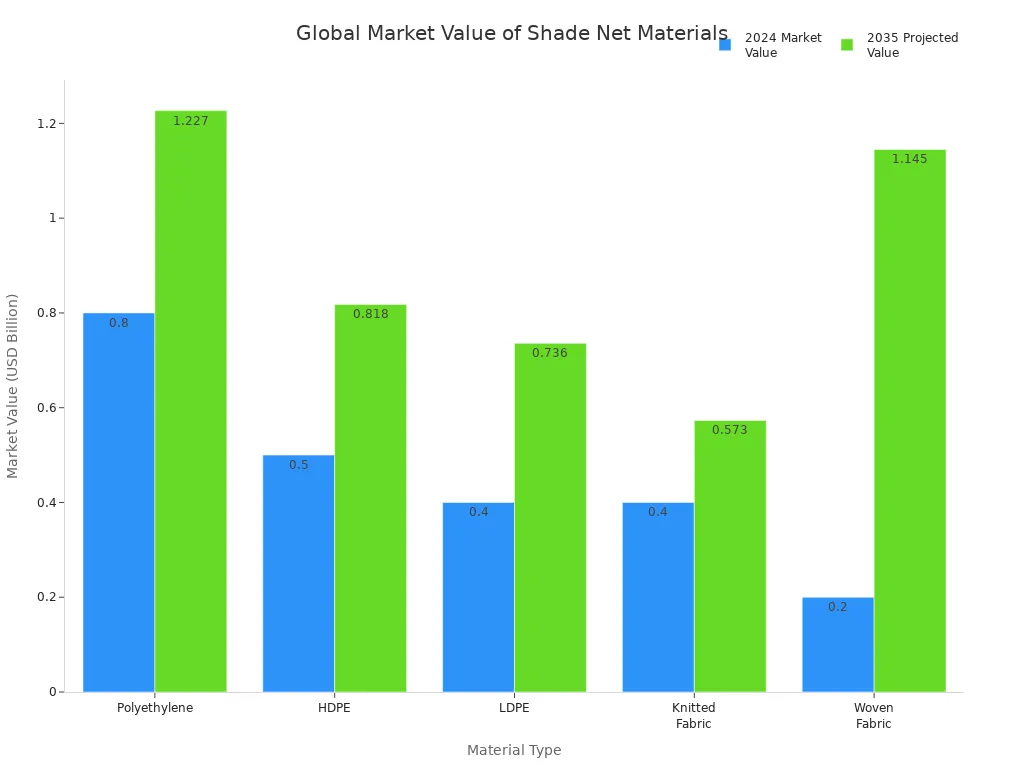
The three main types of knitted shade nets—monofilament, tape, and Raschel—serve essential roles in agriculture, horticulture, and outdoor environments. Monofilament nets provide high durability for crop protection, while tape nets offer lightweight coverage ideal for nurseries. Raschel nets combine strength and flexibility, making them suitable for large outdoor spaces. Selecting the right shade net depends on shade percentage, color, material quality, and UV resistance. Polyethylene and HDPE materials dominate the market due to their durability and UV stability.
| Tipo de material | Market Value 2024 (USD Billion) | Key Feature |
|---|---|---|
| Polyethylene | 0.8 | UV resistance, durability |
| HDPE | 0.5 | Strength, longevity |
| Knitted Fabric | 0.4 | Breathable, lightweight |
Principales conclusiones
- Monofilament, tape, and Raschel knitted redes de sombra each offer unique strengths for different uses in agriculture, nurseries, and outdoor spaces.
- Choosing the right shade net depends on factors like shade percentage, color, material quality, and UV resistance to match specific crop or environment needs.
- High-density polyethylene (HDPE) is the main material for durability and UV protection, extending the net’s lifespan and performance outdoors.
- Proper installation and maintenance, including cutting without unraveling and regular cleaning, help maximize the net’s effectiveness and longevity.
- Shade net color and density affect plant growth and temperature control, so selecting the right combination improves crop yield and outdoor comfort.
Shade Net Types

Monofilamento
Monofilament knitted shade nets use fine, strong yarns woven into a flexible and lightweight mesh. These nets stand out for their abrasion resistance and clean, modern appearance.
- They do not stretch, which allows installers to pull them tightly across structures.
- Monofilament nets resist aging and UV damage, making them easy to maintain and suitable for long-term outdoor use.
- The mesh allows air to circulate, reduces glare, and helps maintain balanced colors in outdoor spaces.
- Unlike tape or woven types, monofilament shade nets do not unravel when cut, so users can customize them without special treatment.
- These nets work well as barriers or fences and perform best in warmer climates where plastic coverings are not needed.
- In agriculture, monofilament shade nets protect crops in vineyards, orchards, and nurseries by regulating sunlight, temperature, and humidity.
- They shield plants from wind, hail, and birds while still allowing airflow and light penetration.
Tip: Monofilament shade nets offer a practical solution for growers who need a balance of strength, flexibility, and easy installation.
Cinta
Tape knitted shade nets use flat, tape-like fibers, making them lightweight and cost-effective.
- These nets provide flexibility, which simplifies installation and handling.
- Tape shade nets are affordable, making them a popular choice for temporary or budget-conscious projects.
- However, they are less durable than monofilament or Raschel types and may require more frequent replacement in harsh weather or high UV environments.
- Tape shade nets work best when paired with plastic in hoop house greenhouses, as they do not offer the same level of strength or UV protection as other types.
- Gardeners often choose tape shade nets for their versatility and ease of customization, but should consider the shorter service life in demanding conditions.
| Tipo de red de sombra | Fiber Type | Fiber Shape | Construction Method | Stretching Ability | Edge Treatment Needed | Shading Rate | Service Life |
|---|---|---|---|---|---|---|---|
| Knitted Shade Cloth | Mono (round) fibers | Round | Knitted | 2-3% stretch | No edge banding needed | Moderado | Longer service life |
| Woven Shade Cloth | Tape (flat) fibers | Flat | Woven (expanded) | Minimal stretch | Requires edge sealing | Better at sthe ame weight | 3-5 years |
| Composite Shade Cloth | Combination of Mono + Tape fibers | Mixed | Composite weaving | 2-3% stretch | No edge banding needed | Better shading rate | Longer service life |
Nota: Tape knitted shade nets offer a balance between affordability and flexibility, but users should weigh these benefits against the need for durability and UV protection.
Raschel
Raschel knitted shade nets feature a unique lock stitch construction, produced from 100% virgin polyethylene using a Raschel knitting process.
- The lock stitch prevents the fabric from unraveling when cut, allowing for easy size adjustments without special treatment.
- Raschel nets combine monofilament yarns in both warp and weft directions, maximizing strength and durability.
- The fabric remains soft and flexible, providing excellent breathability and ventilation for plants.
- Raschel shade nets are highly durable, UV stabilized, and suitable for both large and small tension structures, such as shade sails and commercial shading systems.
- Their wind resistance and dimensional stability make them ideal for outdoor and commercial applications, including construction sites and industrial shading.
| Característica | Raschel Knitted Shade Cloth | Monofilament and Tape Shade Cloth Types |
|---|---|---|
| Manufacturing | Made using a Raschel warp knitting machine from HDPE | Monofilament: single filament yarn; Tape: tape yarn |
| Stitch Type | Unique lock stitch construction prevents unraveling | Monofilament and tape do not have a lock stitch; woven or knitted differently |
| Flexibility | Soft, flexible | Monofilament: less stretch; Tape: less flexible |
| Breathability | Highly breathable due to the knitting method | Denser fabric in tape; monofilament is less breathable |
| Durabilidad | Highly durable with UV resistance | Monofilament is strong and durable; tape is less strong |
| Cutting & Sizing | Can be cut without unraveling or special treatment | Usually requires sealing to prevent unraveling |
| Fabric Density | Moderate, balanced for ventilation and strength | Tape: denser fabric with higher shade rate; monofilament: strong but less dense |
| Aplicación | Ideal for plant shade requiring ventilation and flexibility | Monofilament is suited for harsh weather; tape for cost-effective shading |
Raschel knitted shade nets provide a reliable solution for commercial and industrial users who need long-lasting, flexible, and customizable shading.
Features and Benefits
Material and Durability
High-density polyethylene (HDPE) forms the backbone of most knitted shade nets, accounting for about 95% of their composition. This material delivers outstanding weather resistance and shade performance, making it a preferred choice for agricultural and protective uses. Manufacturers often add color masterbatch, UV stabilizers, and special additives to enhance UV resistance, toughness, and longevity. The purity of HDPE directly impacts tensile strength and product lifespan. Purer HDPE results in denser, heavier nets that withstand greater tension and last longer. UV stabilizers play a crucial role in extending outdoor service life, especially in regions with intense sunlight. While some producers use recycled polyethylene to lower costs, this approach typically reduces durability and performance.
| Shade Cloth Type | Material | Lifespan (years) | Durability Characteristics |
|---|---|---|---|
| Knitted | Polyethylene/Polypropylene (UV-resistant) | 7 – 10 | More durable against tearing; does not unravel if damaged |
| Woven | Polyethylene/Polypropylene (UV-resistant) | 10 – 12 | Denser but unravels more easily if torn |
Proper maintenance, such as regular cleaning and inspection, further extends the lifespan of a shade net, which typically ranges from De 3 a 10 años depending on material quality and UV exposure.
Flexibility and Installation
Knitted shade nets offer high flexibility, allowing them to adapt to irregular shapes and various installation environments. Users can cut these nets to size without worrying about unraveling, which simplifies customization and setup. Installation requires accurate measurement, securing the net to a sturdy frame, and using clips or ties for even attachment. The net should remain taut but not overly tight to prevent damage. Sturdy poles or stakes help withstand wind and environmental stress. Regular inspection and adjustment maintain optimal coverage and prolong the net’s service life.
Consejo: Clean the net with mild detergent and water, remove debris, and store it properly when not in use to maximize longevity.
| Característica | Knitted Shade Netting | Woven Shade Netting |
|---|---|---|
| Flexibility | High flexibility; adapts to irregular shapes easily | More rigid; less adaptable |
| Installation Ease | Easy to install; no special tools needed; does not unravel when cut | Harder to install; often requires specialized tools |
| Mantenimiento | Regular inspection, mild detergent cleaning, prompt repair of tears, and proper storage | Generally, more durable but less flexible maintenance |
| Suitability | Ideal for temporary/mobile setups, construction sites, sports facilities | Best for permanent greenhouses and long-term agricultural use |
| Durabilidad | Can withstand movement without tearing; may require more frequent replacement. | More robust and durable; higher initial cost |
Shade Net Colors
Shade net color significantly influences light transmission and plant growth. Green nets transmit more blue-green light, boosting photosynthetic efficiency and biomass. Beige nets allow the most red and far-red light, resulting in the highest yields and fruit weight, especially for crops like strawberries. Black nets provide the lowest light transmission, which can reduce photosynthetic activity and yield.
| Color de la red de sombra | Características de transmisión de la luz | Effect on Light Spectrum | Plant Growth and Yield Impact |
|---|---|---|---|
| Verde | Highest blue-green light transmission | Increases to blue-to-red light ratio | Improved photosynthesis and biomass; higher yield than black net |
| Beige | Highest red and far-red light transmission | Reduces the blue to red light ratio | Highest yield and fruit weight; enhanced growth |
| Negro | Lowest overall light transmission | No significant effect on light quality ratios | Lowest yield and biomass; reduces photosynthetic activity |
Common color choices vary by application. Crops often use black, white, or green nets, while livestock areas prefer darker colors for maximum shade. Outdoor spaces for people may feature a range of colors based on preference.
Usos y aplicaciones
Agricultura
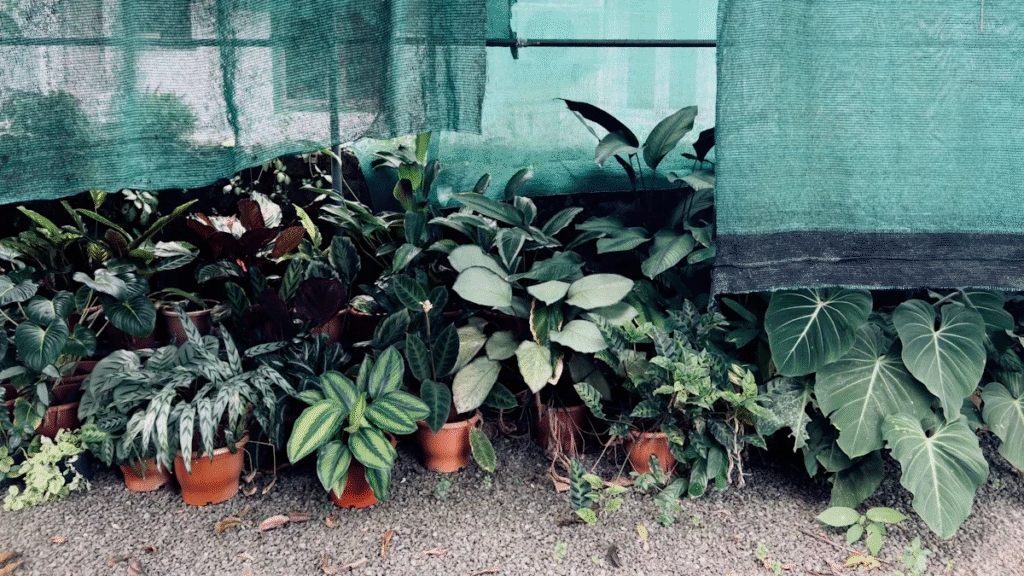
Farmers rely on knitted shade nets to create optimal growing conditions for a wide range of crops. These nets, made from durable polyethylene, help regulate temperature, humidity, and light. By blocking excess sunlight, they prevent heat stress and sunburn on fruits and leaves. Growers can select different shading percentages to match the needs of specific crops, which improves photosynthesis and crop quality. Lighter net colors reflect heat, reducing temperature and water loss, while colored nets can influence plant growth and yield.
Knitted shade nets also serve as physical barriers against pests, birds, and harsh weather. They protect crops from hail, wind, and disease, reducing the need for chemical pesticides. Studies show that using shade nets can increase fruit yields by up to 40% and improve fruit size and quality. Farmers in windy or hot regions benefit from the nets’ flexibility and tear resistance, which ensures long-lasting protection.
Tip: Adjusting the shade percentage and color of the net allows growers to optimize conditions for each crop and season.
Horticulture and Nurseries
Nursery operators and horticulturists use knitted shade nets to protect young plants and seedlings. These nets control temperature and humidity, creating a stable environment that supports healthy germination and uniform growth. By diffusing sunlight, shade nets prevent sunburn and reduce water evaporation, which conserves moisture and lowers irrigation costs.
The nets also act as barriers against pests and birds, reducing the need for pesticides and supporting organic practices. Their lightweight design and open lockstitch construction make installation easy and allow for good airflow, which helps prevent disease. Nursery managers often choose nets with specific colors and densities to tailor light and temperature for different plant species. This approach leads to healthier plants, higher survival rates, and increased yields.
- Regulates temperature and humidity for seedlings.
- Reduces pesticide use by blocking pests.
- Conserves water by limiting evaporation.
- Suppresses weeds by reducing sunlight on nursery beds.
- Promotes even growth across all plants.
Outdoor and Commercial
Knitted shade nets have many uses beyond agriculture and horticulture. Commercial property owners install these nets in parking lots, patios, and outdoor seating areas to provide shade and reduce heat. Construction sites use them as dust barriers and to protect workers from sun exposure. Livestock and poultry farmers use shade nets to keep animals cool and comfortable during hot weather.
Manufacturers design these nets to be strong, breathable, and resistant to wind and water. They offer UV protection and can lower temperatures by up to 35%, improving comfort and safety in outdoor spaces. The nets come in various colors and styles, allowing businesses to match their branding or aesthetic needs. Their recyclable materials and compliance with safety standards make them a sustainable choice for modern commercial environments.
- Provide shade and cooling for patios, parking areas, and playgrounds.
- Serve as dust barriers and safety screens on construction sites.
- Offer thermal comfort for livestock and poultry.
- Enhance outdoor comfort while supporting sustainability goals.
Choosing a Shade Net
Application Needs
Selecting the right knitted shade net starts with understanding the specific application. Different crops, outdoor spaces, and commercial uses require unique net types and specifications. For example, nurseries often benefit from monofilament or knitted nets with higher shade percentages, while open fields may need more durable options to withstand wind. The table below summarizes recommended choices for common scenarios:
| Application Scenario | Recommended Shade Net Type | Shade Percentage (%) |
|---|---|---|
| Greenhouse | Knitted shade netting | 50-70 |
| Open Field | Woven or Knitted shade nets | 30-70 |
| Nursery | Knitted or Monofilament knitted nets | 50-80 |
| Verduras | Knitted shade netting | 50-70 |
| Fruit Trees | Woven or Knitted shade nets | 30-50 |
| Flowers | Knitted shade netting | 50-80 |
Crop type, area size, and installation method all influence the best net choice. Poultry farms and fisheries also have unique needs, such as shelter and environmental control.
Porcentaje de sombra
Shade percentage determines how much sunlight the net blocks. This factor directly affects plant growth, temperature, and energy savings. Most vegetables and herbs thrive under 30%–50% shade, while ornamentals and seedlings may require 50%–70%. Shade-loving plants like orchids need up to 75%. The right percentage depends on plant species, climate, and seasonal sunlight. For example, tomatoes in cooler climates may only need 40% shade, but in hotter regions, up to 80% may be necessary during peak summer. Proper installation, such as maintaining space between the net and plants, ensures good airflow and prevents overheating.
Consejo: Adjust shade percentage seasonally to match changing sunlight and crop requirements.
Factores medioambientales
Environmental conditions play a major role in net performance and longevity. UV radiation, wind, rain, and temperature swings can all impact durability. High-density polyethylene (HDPE) offers excellent UV resistance and is ideal for long-term outdoor use. In hot, sunny climates, white nets reflect heat and keep plants cooler, while black nets suit cooler regions by absorbing warmth. Regular maintenance, including cleaning and inspection, extends the net’s lifespan. Secure installation with sturdy supports helps the net withstand strong winds and harsh weather.
- Choose HDPE for maximum durability and UV protection.
- Match net color to climate: white for hot areas, black for cooler zones.
- Monitor and adjust nets as environmental conditions change.
Comparison Summary
Selecting the right knitted net depends on understanding the differences among monofilament, tape, and Raschel types. Each net offers unique strengths, making them suitable for specific environments and applications. The table below provides a quick reference for comparing their main features and best uses:
| Feature / Net Type | Monofilamento | Cinta | Raschel Knitted |
|---|---|---|---|
| Material | HDPE monofilament | Microfilament HDPE | UV-stabilized HDPE yarn |
| Construction | Leno woven | Raschel drape, triangular | Raschel warp-knitted, diamond |
| Mesh Size | 2mm–8mm | 2mm × 11mm | 8mm–16mm |
| Anchura | Up to 5m | Up to 6m | 6m–20m |
| Opciones de color | Black, white, grey, red | Black, white, green, yellow, red | Black, white, grey, red, green |
| Durability & UV Resistance | High, anti-rip | Durable, anti-rip | Lightweight, highly durable |
| Shade Density | Bajo | Alta | Moderado |
| Air Circulation | Alta | Bajo | Moderado |
| Resistencia al desgarro | Moderado | Alta | Moderado |
| Weight | Not specified | Lightweight | Heavier (>100g/mm²) |
| Coste | Higher | Lower | Higher |
| Mejores usos | Crop and bird protection, long rows | Versatile shading, greenhouses, and parking | Canopy, field coverage, hail, and bird protection |
| Vida útil | Long | Moderado | Over 5 years |
| Regional Preference | Europe | Australia, New Zealand | Growing globally |
Note: Monofilament nets deliver superior durability and UV resistance, making them ideal for long-term crop protection. Tape nets provide high shade density and tear resistance at a lower cost, which suits temporary or budget-conscious projects. Raschel knitted nets combine lightweight construction with high durability, offering stable protection for canopies and large outdoor areas.
When choosing a net, users should consider the balance between cost, durability, shade density, and airflow. The right selection ensures optimal performance and value for each application.
Monofilament, tape, and Raschel nets each serve unique roles in crop protection, nursery care, and outdoor shading. Users should match the net type, shade percentage, and color to their specific needs. Experts recommend the following approach:
- List crops and their light needs.
- Assess local climate and sunlight.
- Choose the right shade percentage.
- Select material and color for durability and climate.
- Plan installation for the sun and wind.
- Monitor and adjust for plant health.
Consulting with suppliers helps ensure the best results for every application.
 Spanish
  English
  German
  French
  Japanese
  Russian