
If you want reliable protection for your crops against harsh sunlight and unpredictable weather, consider using an Agro shade net. This lightweight, high-density polyethylene fabric shields plants from excessive sun and environmental stress, helping you maintain stable growing conditions. The global market for Agro shade nets reached over USD 680 million in 2022, with rapid growth expected, reflecting their proven effectiveness in agriculture. Many farmers choose these nets to improve plant health and safeguard yields.
Principales conclusiones
- Agro shade nets protect crops by controlling sunlight, temperature, and humidity, creating a stable environment for healthy plant growth.
- Choosing the right net color and shading percentage helps match your crops’ light needs and improves yield and quality.
- Shade nets reduce heat stress and water evaporation, saving energy and conserving water for more sustainable farming.
- Durable, UV-stabilized nets shield plants from wind, hail, pests, and harsh weather, ensuring long-lasting crop protection.
- Proper installation and regular maintenance extend the net’s life and maximize benefits for better harvests and economic returns.
Agro Shade Net Overview
Definición
You use an Agro shade net to protect crops from excessive sunlight and environmental stress. This net acts as a barrier, creating a controlled microclimate for your plants. It helps you manage light exposure, temperature, and humidity, which are critical for healthy crop growth. Agro shade nets have become a standard solution in modern agriculture for their ability to improve plant health and yield.
Materiales
Manufacturers typically produce Agro shade nets from lightweight, knitted high-density polyethylene (HDPE). This material offers several advantages for agricultural use. Market research shows that knitted HDPE nets provide flexibility, strength, and excellent tear resistance. You benefit from their uniform shading and good ventilation, which help maintain optimal growing conditions. UV stabilization technology further enhances the durability of these nets, allowing them to withstand prolonged exposure to sunlight without degrading. The knitted structure, created by interlocking loops of yarn, makes these nets easier to handle and install compared to woven alternatives.
Types
You can choose from a wide range of Agro shade nets, each designed to meet specific agricultural needs. The nets vary in color, density, and shading percentage, which directly influence their performance.
- Shading percentages typically range from 35% to 95%. Most agricultural applications use nets that block 50% to 90% of sunlight.
- Black shade nets reduce photosynthetically active radiation (PAR) by about 55–60%. Red nets block 41–51% of PAR, while blue and pearl nets offer intermediate shading.
- The color and mesh size of the net affect the quality and quantity of light reaching your crops. Pearl nets are most effective at reducing harmful UVB and UVA rays. Black nets provide the greatest reduction in PAR, while red nets allow more light through.
- The spectral composition of sunlight under each net changes, which can impact plant growth and yield.
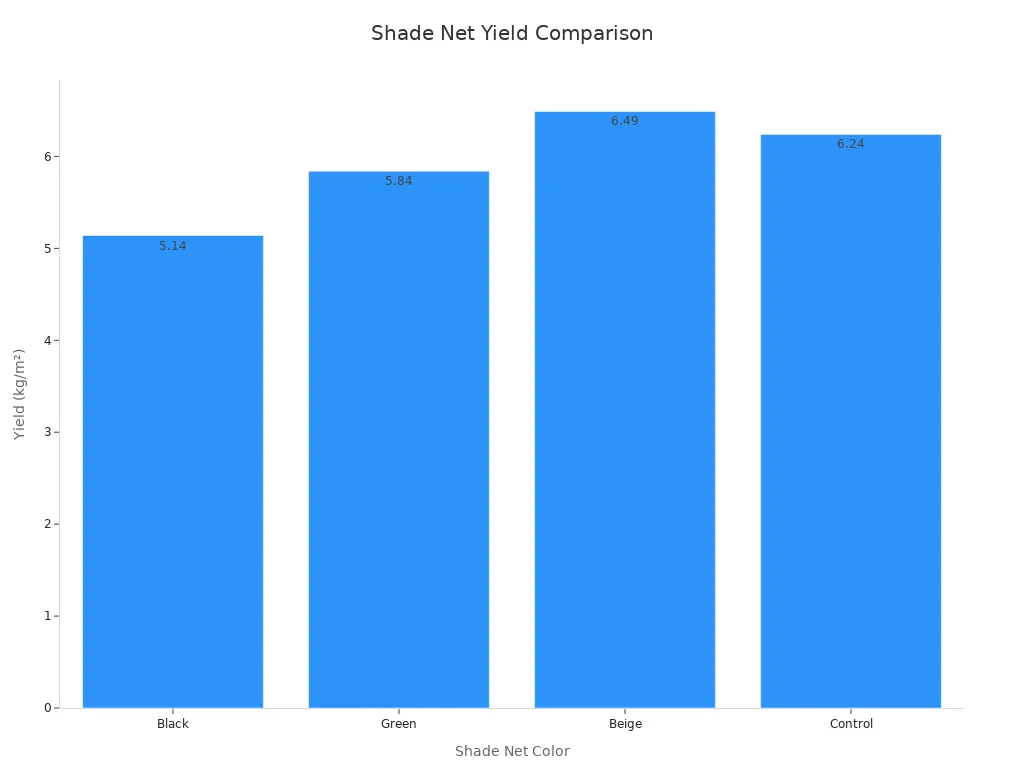
Consejo: Select the color and density of your Agro shade net based on the specific light requirements of your crops. For example, beige and green nets often improve strawberry yield compared to black nets.
| Color de la red de sombra | Effect on PAR (µmol·m⁻²·s⁻¹) | Impact on Light Quality Ratios | Strawberry Yield (kg/m²) | Key Observations |
|---|---|---|---|---|
| Negro | ~250.5 | No significant effect | ~5.14 | Reduced light transmission and yield |
| Verde | ~295.9 | Increased BL/RD by 10% | ~5.84 | Enhanced blue-green light, improved growth |
| Beige | ~277.4 | Reduced BL/RD by 20% | ~6.49 | Increased infrared/red light, highest yield |
| Control (No net) | N/A | N/A | ~6.24 | Baseline for comparison |
You will find Agro shade nets in various sizes and mesh densities, allowing you to cover small garden beds or large commercial fields. The right choice depends on your crop type, local climate, and desired level of protection.
How It Works
Sunlight Control
You rely on an Agro shade net to manage the amount and quality of sunlight your crops receive. The net’s knitted structure diffuses and scatters sunlight, creating a uniform shading effect across your field or greenhouse. This uniformity helps prevent hot spots and reduces the risk of sunburn on sensitive plants. By selecting the right shading percentage, you can control how much solar radiation reaches your crops, which directly influences their growth and development.
- The shading capacity model shows that nets can provide over 50% shading in certain crop rows.
- The relationship between shading and canopy height in soybeans follows a logarithmic pattern, meaning that as shading increases, plant height responds in a predictable way.
- The effectiveness of shading varies depending on the direction you plant and your location’s latitude.
Consejo: Uniform shading not only protects your crops from excessive sunlight but also helps you create a stable microclimate for better plant growth.
Temperature Regulation
An Agro shade net plays a crucial role in regulating temperature within your growing environment. By reducing the amount of direct solar radiation, the net lowers the air temperature inside greenhouses or shade houses. This cooling effect can make a significant difference, especially during hot seasons.
| Aspecto | Quantitative Effect |
|---|---|
| Temperature reduction | Shade nets can lower greenhouse air temperature by 5–10°C |
| Solar radiation transmission | Nets decrease the amount of solar energy entering space |
| Temperature uniformity | Diffused light leads to a more even temperature distribution |
| Relative humidity uniformity | Improved humidity balance supports consistent plant growth |
| Cooling load and energy saving | Lower heat buildup reduces the need for artificial cooling |
| Plant growth impact | Stable conditions promote uniform crop development |
You benefit from these effects by maintaining optimal temperatures for your crops, reducing heat stress, and saving on energy costs for cooling systems. The improved uniformity in temperature and humidity also leads to more consistent and higher-quality yields.
Protection Features
When you use an Agro shade net, you gain more than just sunlight and temperature control. The net acts as a physical barrier, shielding your crops from a range of environmental threats. The durable, tear-resistant HDPE material, combined with advanced knitting technology, ensures long-lasting protection.
You can expect the following benefits:
- Reduced damage from wind, hail, frost, mist, and heavy rain.
- Lower evaporation rates, which help conserve soil moisture.
- Protection against birds and insects that can harm your plants.
Manufacturers design these nets with UV stabilization, so they resist degradation from sunlight and maintain their strength over time. Field tests on crops like kiwis have shown that using protective nets increases both fruit quality and quantity. Some nets even come with warranties of up to 10 years, highlighting their durability and reliability in harsh outdoor conditions.
Nota: By installing an Agro shade net, you create a safer and more controlled environment for your crops, leading to healthier plants and better harvests.
Benefits
Crop Yield
You can expect a noticeable improvement in crop yield when you use shade nets. These nets create a favorable microclimate by reducing heat stress and limiting the impact of direct sunlight. As a result, your crops grow healthier and produce better-quality harvests. Many farmers have reported the following benefits:
- Enhanced crop quality and increased yields, especially in areas with intense sunlight.
- Reduced water evaporation, which supports better resource efficiency.
- Improved food security and more sustainable farming practices.
- For certain crops like berries, fruits, and fruity vegetables, shading up to 40% can increase yields or minimize losses.
- Bell peppers grown under about 26% shade may produce fewer fruits, but the fruits are larger and heavier, maintaining or even improving total yield.
- Blueberries in subtropical regions show higher yields due to reduced plant stress.
- Shading can extend the harvesting period and boost cumulative yields in crops like blackberries.
You should note that maize and grain legumes are more sensitive to shading and may experience yield declines. By optimizing shade levels, you can maximize the benefits for your specific crops.
Water Savings
Shade nets help you conserve water by significantly reducing evaporation from soil and plant surfaces. This benefit is especially valuable in regions facing water scarcity or high temperatures. The following table highlights key water conservation metrics:
| Metric | Value/Range | Descripción |
|---|---|---|
| Evaporation Suppression Efficiency (ESE) – Black net at 90% shading | 56.8% | Highest evaporation reduction |
| ESE – Green net at 90% shading | 53.6% | Strong evaporation suppression |
| ESE – White net at 90% shading | 51.7% | Notable evaporation suppression |
| Evaporation Rate Reduction in Australia | 90% | Major reduction using shade covers |
| Evaporation Rate Reduction in Spain | 85% | High reduction with shade covers |

You also benefit from improved water quality, as shade nets lower electrical conductivity and nitrate concentrations in irrigation water. These advantages support both economic savings and sustainable resource management.
Durabilidad
You gain long-term value from shade nets due to their robust construction and UV stabilization. Manufacturers design these nets to withstand harsh weather, including strong sunlight, wind, and rain. Many nets last for several years, even with continuous outdoor use. You can use them in a variety of settings, such as open fields, greenhouses, gardens, and terraces. Their durability reduces the need for frequent replacements, saving you time and money while ensuring reliable crop protection.
Applications

Crops
You can protect a wide variety of crops using an Agro shade net. Farmers often use these nets for vegetables such as tomatoes, sweet peppers, and coriander. Fruit crops like strawberries, blueberries, and apples also benefit from shade netting. In tea plantations, different colored nets help you control light quality, which improves both plant growth and leaf quality throughout the season. Research shows that black nets reduce light intensity, while blue and red nets filter specific wavelengths, influencing photosynthesis and the production of valuable plant compounds. You will also see improvements in fruit size, yield, and postharvest quality, especially when using pearl nets for fruit trees. By reducing pest and disease pressure, you help your crops stay healthier and more productive.
Settings
You can install Agro redes de sombra in many settings to create optimal growing conditions. Greenhouses and shade houses use these nets to manage sunlight and temperature, supporting sensitive crops year-round. Home gardeners often use shade nets to protect plants in backyard gardens or on balconies. Commercial growers cover large fields or orchards to shield crops from wind, hail, and sunburn. In subtropical orchards, shade nets lower canopy temperature and wind speed, while increasing humidity. This helps you maintain a stable environment for your plants, leading to better growth and higher yields.
Tip: Choose the net color and shading percentage based on your crop’s needs and your local climate for the best results.
Other Uses
You can use Agro shade nets beyond traditional farming. Many people install them over patios, playgrounds, or parking areas to provide shade and comfort. Nurseries use shade nets to protect young plants from harsh weather and pests. In landscaping, these nets help you create shaded walkways or outdoor seating areas. Shade nets also reduce evaporation from water reservoirs, helping you conserve water in dry regions. Their versatility makes them valuable in both agricultural and non-agricultural settings.
Choosing and Using
Selection Tips
Selecting the right Agro shade net depends on your crop’s light needs, local climate, and budget. You should match the net’s density and color to your plants and growing conditions. Scientific studies show that both the density and color of shade nets affect how much sunlight and heat reach your crops. Color often has a greater impact than density. The shading factor changes throughout the day, so you need to consider daily sunlight patterns.
- Use 30% density nets for sun-loving vegetables and herbs that need plenty of light with some protection.
- Choose 50% density for most flowers and crops that require a balance of sunlight and shade.
- Select 70% or higher for delicate plants, ferns, or young seedlings that need significant shade.
- Consider local weather, UV exposure, and wind when choosing net durability and UV resistance.
- Factor in ease of installation, maintenance needs, and your budget.
Consejo: Always match the net’s density and color to your crop’s specific requirements and your local environment for the best results.
Instalación
Proper installation ensures your shade net lasts and protects your crops effectively. Start by assessing your site to match the net to your crop and climate. Secure the net tightly to withstand wind and weather. Use strong support structures like poles or frames. Make sure the net covers the area evenly without sagging. Fasten the edges and corners well to prevent tearing or movement.
- Check that the net does not touch the plants directly.
- Leave enough space for air to circulate under the net.
- Inspect all fastenings and supports regularly.
A well-installed net can last 5 to 10 years, depending on conditions and care.
Mantenimiento
Regular maintenance keeps your Agro shade net in top condition. Clean the net gently with a soft brush and mild soap. Avoid harsh chemicals that can damage the fibers. Inspect the net often for signs of wear, such as fraying, holes, or loose connections. Repair small holes or weak spots right away to prevent bigger problems. Replace the net if you see extensive damage.
- Apply protective coatings if recommended by the manufacturer.
- Train workers or users on proper handling to avoid overloading or stretching the net.
- Plan seasonal maintenance, especially before periods of heavy use or harsh weather.
Nota: Consistent care and timely repairs help your net last longer and keep your crops safe.
You gain significant advantages when you use shade nets for crop management.
- Increase yields by up to 40% for fruits and berries
- Regulate temperature and humidity, reducing heat stress
- Block harmful UV rays and conserve soil moisture
- Lower pest populations and reduce pesticide use
- Improve crop quality and economic returns
You can tailor shade nets to your specific crops and climate. Consider installing them to protect your plants, boost yields, and support sustainable farming.
 Spanish
  English
  German
  French
  Japanese
  Russian