
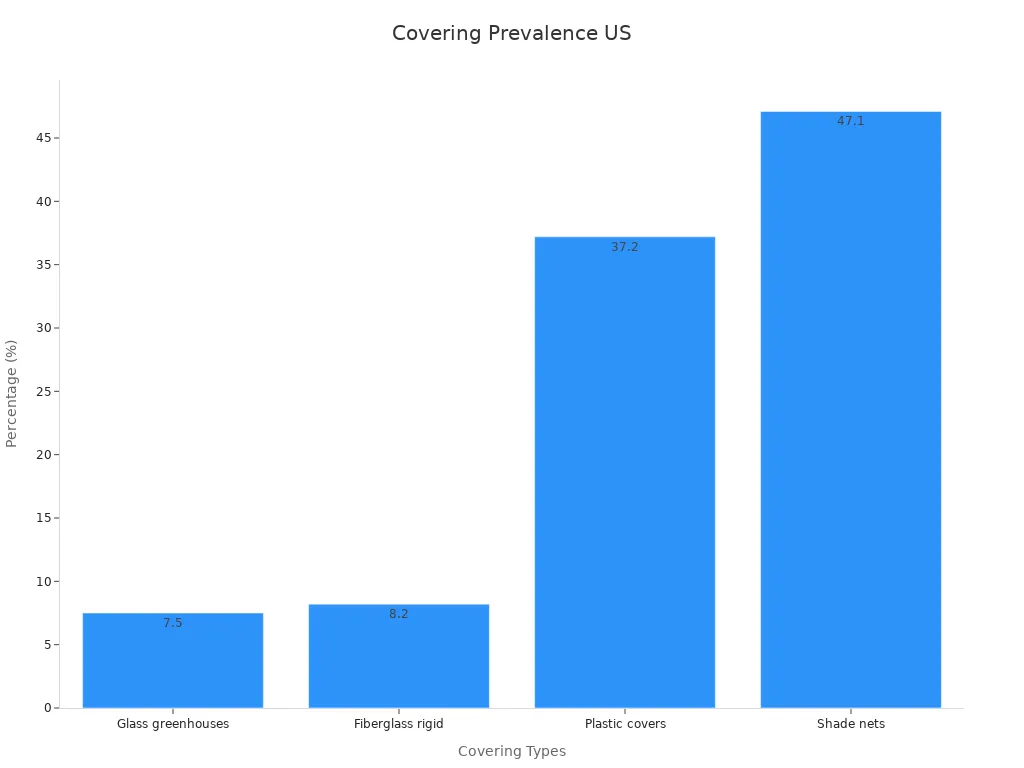
Choosing the right knitted shade net starts with understanding its main types: Monofilament nets offer high durability for long-term agricultural use, Tape nets provide cost-effective shading for car parks and outdoor spaces, and Raschel nets deliver flexible density for delicate horticultural environments. Most growers prefer shade nets, with 47.1% of covered horticultural areas in the US using them, reflecting their efficiency and versatility.
| Aspect | Statistic / Finding | Application / Implication |
|---|---|---|
| Distribution of covered environments in the US | 47.1% shade nets or temporary covers | Shade nets dominate horticultural production environments |
| Effects of spectral quality on plants | Red and pearl nets improve tomato fruit quality | Specific net types enhance crop outcomes |
Key Takeaways
- Knitted shade nets come in three main types: monofilament, tape, and Raschel, each with unique strength and flexibility suited for different uses.
- Monofilament nets offer the highest durability and strength, making them ideal for long-term agricultural and greenhouse protection.
- Tape nets provide a budget-friendly option with moderate strength, perfect for temporary shading in car parks and outdoor events.
- Raschel nets combine flexibility and resilience, allowing precise control of shade and airflow, which benefits delicate crops and windy environments.
- Choosing the right net type and shading density helps protect plants, vehicles, and outdoor spaces while improving comfort and productivity.
About Knitted Shade Net
What It Is
Knitted Shade Net refers to a protective mesh made by interlocking loops of yarn, usually from high-density polyethylene (HDPE). Manufacturers design these nets to provide shade and regulate sunlight for crops, vehicles, and outdoor spaces. The production process involves extruding HDPE film into strips, then knitting them into a flexible net. This method aligns the HDPE molecules, giving the net both strength and stretchability. Elemental analysis confirms that carbon is the main element in the fibers, consistent with the chemical structure of HDPE ((C2H4)n).
| Property | Value |
|---|---|
| Chemical composition | (C2H4)n (HDPE) |
| Volumetric density | 0.941–0.965 g/cm³ |
| Tensile strength | 24.7 MPa |
| Relative elongation at yield | >9.1% |
| Temperature resistance | −50°C to +80°C |
These properties make Knitted Shade Net suitable for agricultural and horticultural environments, where flexibility and mechanical strength are essential.
Key Features
Knitted Shade Net stands out for its durability, UV protection, and ease of use. Several features make it a preferred choice over woven nets:
- The net resists tearing, fraying, and unraveling, which extends its lifespan.
- UV-stabilized polymers protect crops and vehicles from harsh sunlight and weather.
- The open lockstitch design reduces heat build-up and wind damage.
- Installation is simple, and edge taping is not required.
- The net resists most horticultural chemicals and detergents, making it ideal for demanding environments.
Manufacturers have introduced hybrid nets that combine knitted and woven structures, further improving strength, flexibility, and UV protection. Many companies now use recycled and eco-friendly materials, enhancing sustainability without sacrificing performance.
Field tests and market research confirm that Knitted Shade Net offers superior performance in agriculture and horticulture. Its lightweight design and chemical resistance make it easy to handle and maintain, supporting long-term use in various climates.
Knitted Shade Net Types
Monofilament
Monofilament shade nets use high-quality virgin HDPE monofilament yarn. Manufacturers design these nets with a knotless, diamond-shaped mesh that ranges from 15 to 25 mm. The construction often features 2-bar or 3-bar designs, such as Mono x Mono or Tape x Mono, which distribute loads efficiently and enhance durability. Monofilament yarn provides greater strength than tape yarn, making these nets suitable for demanding environments.
| Specification | Details / Values |
|---|---|
| Material | Virgin HDPE monofilament yarn, knotless mesh |
| GSM Range | 18–350 g/m² |
| Width | Up to 6.4 m |
| UV Stability | Up to 640 KLY (approx. 10 farming seasons) |
| Warp Strength | 402.2 N (Duraluminet) |
| Weft Strength | 268.6 N |
| Elongation | Warp: 16.2%, Weft: 24.8% |
| Color Options | Blue, Transparent, Black, White, Red, Green, and combinations |
Monofilament nets excel in tensile strength and elongation, as laboratory tests confirm. These nets resist UV degradation and last for many years, even in harsh climates. Farmers and facility managers often choose monofilament nets for greenhouses, nurseries, and long-term agricultural protection. The higher cost reflects their superior performance and extended service life.
Tip: Monofilament shade nets offer the best choice for users who require maximum durability and long-term investment.
Tape
Tape shade nets use flat HDPE tape yarns, which manufacturers knit into a mesh structure. The tape yarns provide a balance between cost and shading efficiency. These nets typically have a lower GSM (grams per square meter) than monofilament types, making them lighter and more affordable.
- Tape nets deliver moderate tensile strength, which increases with wider and thicker tape yarns.
- The density and shading percentage can be adjusted by changing the number of pillar yarns per unit area.
- Tape nets are available in a wide range of colors and shading factors, making them versatile for different environments.
Tape shade nets work well for car parking, temporary crop protection, and outdoor event spaces. Their cost-effectiveness and ease of installation make them a popular choice for users who need reliable shading without the higher investment of monofilament nets. However, tape nets may not match the mechanical strength or lifespan of monofilament or Raschel knitted shade nets.
Note: Tape shade nets provide a practical solution for users who prioritize budget and flexibility over maximum strength.
Raschel
Raschel knitted shade nets stand out for their unique structure and mechanical properties. Manufacturers use specialized knitting machines to create a lockstitch pattern, which gives the net excellent stretchability and porosity stability. The physical structure of Raschel nets results in anisotropic mechanical behavior, meaning the net responds differently to forces depending on the direction.
Mechanical and field tests show that Raschel knitted shade nets can withstand significant wind and impact loads. For example, wind tunnel and field experiments demonstrate that these nets can handle forces up to 50 kg at wind speeds of 150 km/h when properly supported. The nets also resist hailstone impacts and maintain their integrity under repeated stress.
- Raschel nets allow precise control over porosity and shading percentage, making them ideal for delicate crops and orchards.
- The nets’ structure supports high air permeability and effective light diffusion, which benefits plant growth.
- Users often select Raschel knitted shade nets for greenhouses, orchards, and environments where both protection and ventilation are critical.
Raschel knitted shade nets combine mechanical resilience with flexible shading options, making them suitable for a wide range of agricultural and horticultural applications.
Comparing the Types
| Type | Material & Structure | Strength & Durability | Density Range (GSM) | Best Uses | Cost-Effectiveness |
|---|---|---|---|---|---|
| Monofilament | Virgin HDPE monofilament | Highest | 18–350 | Greenhouses, nurseries, and long-term covers | Moderate-High |
| Tape | Flat HDPE tape yarn | Moderate | Lower than mono | Car parks, temporary shading, and events | High |
| Raschel | Knitted lockstitch (HDPE) | High, flexible, resilient | Variable | Orchards, greenhouses, wind/hail protection | Moderate |
Mechanical studies confirm that each type of Knitted Shade Net exhibits distinct behaviors based on material and structure. Monofilament nets provide the highest strength and longevity. Tape nets offer cost savings and easy handling. Raschel knitted shade nets deliver superior adaptability and resilience, especially in environments exposed to wind and impact.
Uses and Applications

Agriculture and Horticulture
Farmers and horticulturists rely on different types of knitted shade nets to create optimal growing environments. Monofilament nets provide strong, long-term protection for greenhouses and nurseries. These nets withstand harsh weather and resist UV degradation, making them ideal for permanent installations. Tape nets offer a cost-effective solution for temporary shade in shade houses, tunnels, and trellising systems. Raschel knitted shade nets allow growers to adjust shading density, which helps protect delicate crops like flowers and young vegetables. Many growers use these nets to control light, temperature, and humidity, which improves plant health and increases yields.
Tip: Selecting the right net type and density ensures crops receive the correct amount of sunlight and protection from wind or hail.
Car Parking
Knitted shade nets play a vital role in protecting vehicles in car parking areas. Manufacturers recommend nets with 90%-95% density for these spaces. These nets block most sunlight, allowing only 5%-10% of light to pass through. As a result, car roofs stay cooler, and interiors remain comfortable even during heat waves. The nets also shield vehicles from ultraviolet rays and other weather disturbances. Many commercial and household sectors now use these nets to reduce sun damage and improve the usability of parking spaces. In addition, shade nets act as privacy barriers by darkening the covered area.
- Reduce heat buildup inside vehicles.
- Protect car exteriors from UV rays and weather
- Enhance privacy and security in parking lots
Outdoor Spaces
Event organizers and property managers use knitted shade nets to create comfortable outdoor environments. Tape nets work well for temporary shading at events, playgrounds, and patios due to their lightweight and easy installation. Raschel nets provide flexible shading for sports facilities and recreational areas, where airflow and light diffusion are important. Monofilament nets serve in permanent outdoor structures that require high durability. Common settings include garden walkways, outdoor seating, and community gathering spaces. By choosing the right net type, users can balance shade, ventilation, and aesthetics for any outdoor application.
Selecting the right knitted shade net depends on strength, density, and intended use. Users should match the net type to their environment and crop needs. Experts recommend considering these factors:
- Choose higher shading percentages (up to 95%) for car parks or sensitive crops.
- Select flexible, tear-resistant nets for windy locations.
- Match material type and density to plant light requirements.
- Use durable knitted nets to reduce temperature stress and conserve water.
A careful selection process ensures optimal protection and productivity in every application.
 English
  German
  French
  Japanese
  Spanish
  Russian